
App Development Process in UAE
Key Takeaways
- The app development process in the UAE typically runs 3 to 9 months from discovery to launch, depending on scope and platform count.
- Discovery and scoping is the phase most founders rush, and it’s the one that determines whether every later phase stays on budget.
- Arabic RTL support adds real cost and time when built in from sprint one, and significantly more when bolted on after the English version ships.
- AED pricing scales sharply by tier: roughly AED 25,000 to 90,000 for a focused MVP, AED 150,000 to 400,000 for a mid-complexity B2C app, and AED 500,000 upward for enterprise builds with multiple integrations.
- PDPL compliance and UAE-specific payment gateway integration (Telr, PayTabs, Tabby, Tamara) need to be scoped at the architecture stage, not added late.
- QA and testing is frequently underbudgeted, even though it’s where most launch delays actually originate.
- Post-launch maintenance runs 15 to 25 percent of the original build cost annually, and businesses that skip this in their planning are consistently surprised by it.
Most founders who come to an app development conversation for the first time have a rough idea of what they want built and almost no sense of what actually happens between that idea and a live app on the App Store. That gap causes real problems. Budgets get set without understanding what drives cost. Timelines get promised without understanding what determines them. And the phase that matters most, discovery, gets treated as a formality to rush through on the way to “real” work.
The UAE app market has matured fast. Founders here are more sophisticated than they were even two years ago, but the process itself, what actually happens at each stage and why it takes the time it takes, still isn’t well understood outside development teams.
This breaks down the full app development process the way it actually runs for UAE businesses, phase by phase, with realistic AED pricing and the specific mistakes that push projects over budget.
Phase One: Discovery and Scoping
Every app project starts here, and the quality of this phase quietly determines the health of every phase after it. Discovery is where a vague idea turns into a defined scope: what the app does, who it’s for, which platforms it ships on, and which features are genuinely necessary for launch versus which ones can wait.
This phase typically runs one to three weeks, and rushing it is the single most common reason projects run over budget later. A founder who skips proper requirements gathering to save two weeks of planning time routinely pays for that decision in redesigns, backend rework, or a feature set that doesn’t match what users actually needed.
Discovery should produce a written scope document, a rough technical architecture plan, and a clear answer to the platform question: native iOS, native Android, or a cross-platform framework like Flutter or React Native that ships both from a single codebase. That last decision alone can shift the total budget by a meaningful margin, and it needs to be made with actual tradeoffs in mind, not by default.
For UAE-specific projects, discovery is also where compliance requirements get mapped. PDPL data handling obligations, whether the app needs UAE-hosted data residency, and which payment gateways the business needs (Telr, PayTabs, Tabby, and Tamara are the common local expectations) all need to be identified here, because retrofitting compliance into an already-built architecture is expensive and sometimes not fully possible without a rebuild.
Phase Two: UX and UI Design
Once scope is locked, design translates the plan into wireframes, user flows, and eventually a full visual system. This phase usually takes three to six weeks depending on complexity, and it often runs longer than founders expect, because good design isn’t just screens. It’s the logic of how a user moves from one action to the next without friction.
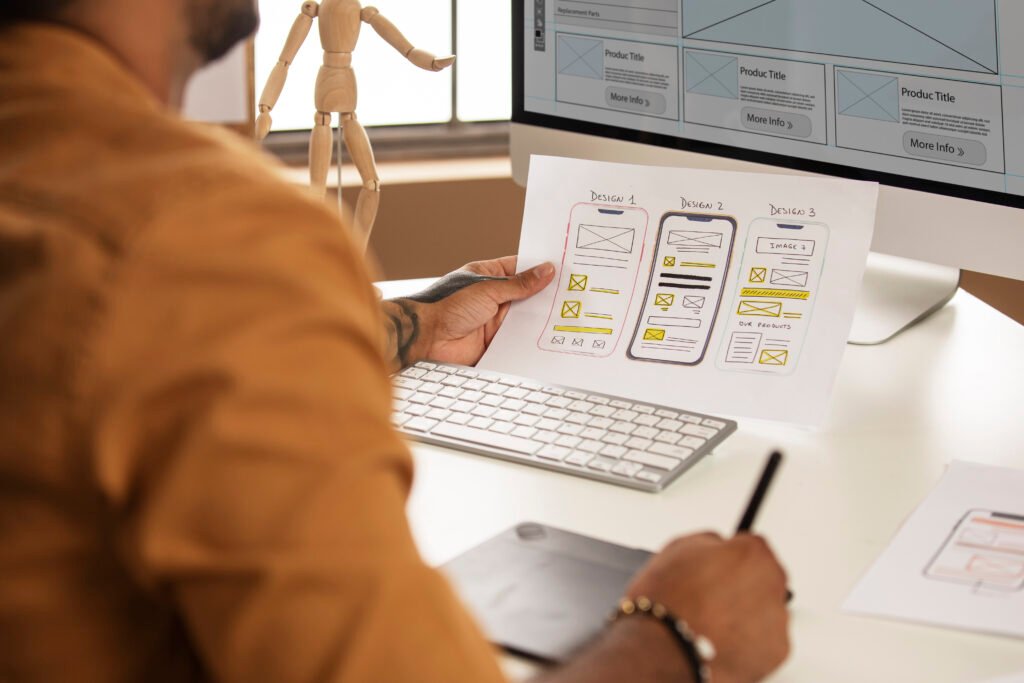
Wireframes come first, low-fidelity layouts that map structure and flow before anyone worries about color or typography. From there, the design moves into high-fidelity mockups and eventually a clickable prototype that stakeholders can actually walk through before a single line of production code gets written.
Arabic RTL support belongs here, not later. Building right-to-left directionality into the design system from the start typically adds 15 to 25 percent to design cost. Bolting it on after the English version is already built and approved routinely costs 30 to 40 percent more, because layouts that were considered finished need to be refactored rather than designed correctly the first time. This is one of the most consistent, avoidable cost overruns in UAE app projects, and it happens because RTL gets treated as a translation task instead of an architectural one.
Phase Three: Development
This is usually the longest phase, running anywhere from eight weeks for a focused MVP to several months for a full-featured platform. Engineers build the interface, the backend services, the database structure, authentication flows, and any third-party integrations the app needs to function.
Backend architecture decisions made here have long consequences. A database structure that wasn’t built to scale, or an API design that doesn’t account for future features, becomes expensive to fix once real users and real data are already in the system. This is why the discovery and architecture planning from Phase One matters so much: a well-scoped project moves through development with fewer surprises, while a poorly scoped one hits unplanned rework constantly.
Development is typically split into sprints, with working builds released for internal review at regular intervals rather than one long stretch of invisible progress followed by a single reveal at the end. This structure catches problems early, when they’re cheap to fix, instead of during final QA, when they’re not.
Phase Four: QA and Testing
Quality assurance is the phase most frequently underbudgeted, and it’s also the phase most directly responsible for launch delays when it’s rushed. Testing needs to cover functional behavior, device and OS compatibility across the range of phones UAE users actually carry, security vulnerabilities, and performance under real network conditions, not just a fast office WiFi connection.
Given how much UAE mobile traffic runs on cellular networks with variable speed, performance testing under realistic, sometimes slower, network conditions matters more here than in markets with more uniformly strong connectivity. An app that only gets tested on fast WiFi will surface problems for the first time in production, exactly where you don’t want to find them.
This phase usually runs two to four weeks for a mid-complexity app, longer for anything handling payments, sensitive user data, or real-time features like chat or live tracking. Security testing specifically deserves real time here, particularly for apps integrating UAE payment gateways or handling PDPL-regulated personal data.
Phase Five: Launch and Deployment
Launch involves submitting to the Apple App Store and Google Play Store, each with its own review process and its own set of requirements that catch teams off guard when they haven’t prepared for them in advance. Apple’s review can take anywhere from a day to over a week depending on the app category and how closely it follows platform guidelines. Google Play’s process tends to move faster but still requires careful attention to policy compliance, particularly around data handling disclosures.
Store listing preparation, screenshots, description copy, keyword optimization for app store search, needs to happen in parallel with final development, not as an afterthought once the build is already submitted. App Store Optimization functions similarly to SEO in that it determines whether people can actually find the app once it’s live, and treating it as a last-minute checkbox wastes the visibility opportunity that a well-optimized listing provides.
Phase Six: Post-Launch Support and Maintenance
Launch is not the finish line, even though it often gets treated that way in initial budget conversations. Every app needs ongoing maintenance: OS updates from Apple and Google that require compatibility fixes, bug reports from real users doing things the QA phase didn’t anticipate, and security patches as vulnerabilities get discovered across the broader software ecosystem.
Budget planning should account for 15 to 25 percent of the original development cost annually for maintenance and updates. Businesses that don’t plan for this figure are consistently surprised by it roughly six months after launch, when the first round of OS updates or user-reported bugs arrives and there’s no budget allocated to address them.
What Drives AED Pricing at Each Stage
App development pricing in the UAE spans a wide range, and understanding where a project sits on that spectrum starts with matching scope to tier rather than picking a number and working backward.
Typical Investment by Tier
- Focused MVP, single core feature set: AED 25,000 to 90,000
- Mid-complexity B2C app, multiple user roles, payment integration: AED 150,000 to 400,000
- Enterprise platform, complex integrations, real-time features, full compliance: AED 500,000 and upward
Several factors push a project from one tier into the next. Multiple user roles, such as a customer app paired with an admin dashboard, add real backend complexity. Real-time features like live chat, live location tracking, or push notification systems require infrastructure that a simple content-display app doesn’t need. Payment gateway integration with UAE-specific providers adds both development time and compliance overhead. And Arabic RTL support, done correctly from the start, adds a defined percentage to design and development cost that’s far cheaper to plan for upfront than to retrofit.
Common App Development Process in UAE Mistakes That Delay Launch
A handful of patterns show up repeatedly across delayed or over-budget UAE app projects.
Treating discovery as optional. Founders eager to see visible progress often push to skip ahead to design or development before scope is genuinely locked, and the rework this creates later almost always costs more than the time saved upfront.
Deciding on RTL support too late. As covered above, this single decision point accounts for a disproportionate share of budget overruns in UAE-market apps.
Underestimating QA timelines. Squeezing testing to protect a launch date tends to move problems from a controlled pre-launch environment into a live one, where they’re far more visible and far more expensive to fix.
No maintenance budget planned from day one. A launch budget that doesn’t account for the 15 to 25 percent annual maintenance figure sets up a funding gap the moment the app needs its first post-launch update.
Choosing platform strategy based on assumption rather than data. Deciding between native and cross-platform development without actually reviewing target user device data, iOS versus Android split, browser and OS versions, leads to either overspending on native builds for an audience that didn’t need them, or underdelivering performance for an audience that did.
Team Structure: Who Actually Touches Your App
A common blind spot for first-time app founders is not knowing who’s actually working on the project at each stage, or how many hands the code passes through before it reaches them. This matters more than it sounds like it should, because team continuity affects both quality and cost.
A typical project team includes a product or project manager coordinating scope and timeline, a UX/UI designer handling wireframes through final visual design, one or more developers split across frontend, backend, and mobile-specific work depending on platform choice, and a QA specialist running testing independently from the developers who wrote the code being tested. Larger enterprise builds add a dedicated backend architect and sometimes a DevOps specialist managing deployment infrastructure separately from application code.
Founders should ask directly who stays on the project from discovery through launch versus who rotates in for specific phases. High turnover mid-project, common at agencies running lean teams across too many simultaneous clients, tends to reintroduce the discovery problem partway through, because a new developer picking up someone else’s half-finished code needs time to understand decisions they weren’t part of making. That ramp-up time gets billed, and it rarely shows up as a clearly labeled line item.
Communication Cadence and What Progress Actually Looks Like
Agile development, the sprint-based structure most modern app projects follow, is built around short, fixed-length work cycles, typically one to two weeks, each ending with something tangible to review. This matters for founders because it changes what “progress” should look like from the outside.
A healthy project produces visible checkpoints regularly: a clickable prototype after design, a working build with core navigation after early development sprints, incremental feature releases as the build progresses. A project where weeks pass with only status updates and no actual builds to look at is a signal worth raising early, not something to wait out until the original launch date arrives and the gap becomes impossible to ignore.
Regular demo sessions, ideally every one to two weeks, give founders the chance to catch misalignment while it’s still cheap to correct. Catching a navigation flow that doesn’t match user expectations during a week-three demo costs an afternoon of design revision. Catching the same problem after the app is fully built and in QA costs considerably more, in both time and morale across the team.
Why Transparent Process Beats Vague Timelines
A recurring frustration among UAE businesses that have worked with agencies before is vague scoping paired with vague timelines, the kind of engagement where “it depends” is the answer to every question until the invoice arrives. A properly run app development process gives a business a written phase-by-phase breakdown, realistic AED figures per phase, and a timeline built on the actual scope rather than an optimistic guess designed to win the pitch.
How long does the app development process take in the UAE?
Most projects run 3 to 9 months from discovery to launch. A focused MVP with a single core feature set can move faster, sometimes 10 to 14 weeks, while enterprise platforms with multiple integrations and user roles often extend past 9 months.
What’s the first step in building an app?
Discovery and scoping. This phase defines what the app actually does, who it’s for, which platforms it targets, and what the realistic budget and timeline look like before any design or development work begins.
How much does it cost to build an app in Dubai?
Costs typically range from AED 25,000 for a focused MVP to AED 400,000 for a mid-complexity app with multiple user roles and payment integration, with enterprise platforms reaching AED 500,000 and beyond depending on complexity.
Does Arabic support really add that much to app development cost?
Yes, when it’s an afterthought. Building RTL support into the design system from sprint one typically adds 15 to 25 percent to design cost. Adding it after the English version is already built usually costs 30 to 40 percent more because existing layouts need to be reworked rather than built correctly the first time.
What happens after the app launches?
Ongoing maintenance, OS compatibility updates, bug fixes, and security patches. Budget roughly 15 to 25 percent of the original development cost annually to keep the app functional and secure after launch.
Should I build native apps or use a cross-platform framework?
It depends on your audience and feature requirements. Cross-platform frameworks like Flutter can ship iOS and Android from one codebase, often at lower cost, while native development gives more control over performance-heavy features. The right choice depends on actual user device data and feature complexity, not a default assumption.
Start Your App Development Process With a Clear Scope
A well-run app development process starts with an honest scoping conversation, not a rushed quote. Martian builds UAE apps with PDPL compliance, RTL architecture, and local payment gateway integration planned from Phase One, not patched in after the fact.
Talk to Martian about your app project and get a phase-by-phase scope with realistic AED pricing before any development work begins.