Last year I audited a website for a business owner in Abu Dhabi. Four years in business. Good product. Well-built site. And yet when I searched for his main service, he was on page three, behind a competitor who had only been operating for eighteen months.
Nothing was catastrophically wrong. He just had not done the basics.
That is what this guide is about. Not advanced tactics or clever hacks. Just the things that Google actually responds to, explained in the order you should do them.
What Actually Affects Google Rankings in the UAE
Google is trying to answer a question. Every search is someone asking something, and its job is to find the most useful, credible response. When you understand that, SEO stops feeling complicated. You are just building the signals that help Google trust your answer.
The UAE adds its own wrinkles to this.
Bilingual search behaviour. Arabic-speaking users make up a significant share of searches here. An English-only website is invisible to them, full stop. Most businesses have never thought about this.
Mobile-first indexing. Google uses the mobile version of your site to determine rankings. Not desktop. If your site loads slowly on a phone or breaks on smaller screens, your rankings suffer whether the desktop version is perfect or not. In the UAE, nearly every search is happening on a device in someone’s hand.
Well-funded competition. In real estate, healthcare, legal, and finance, the businesses competing for top Google positions in Dubai have been investing in SEO for years. You are entering an established contest, not a fresh one.
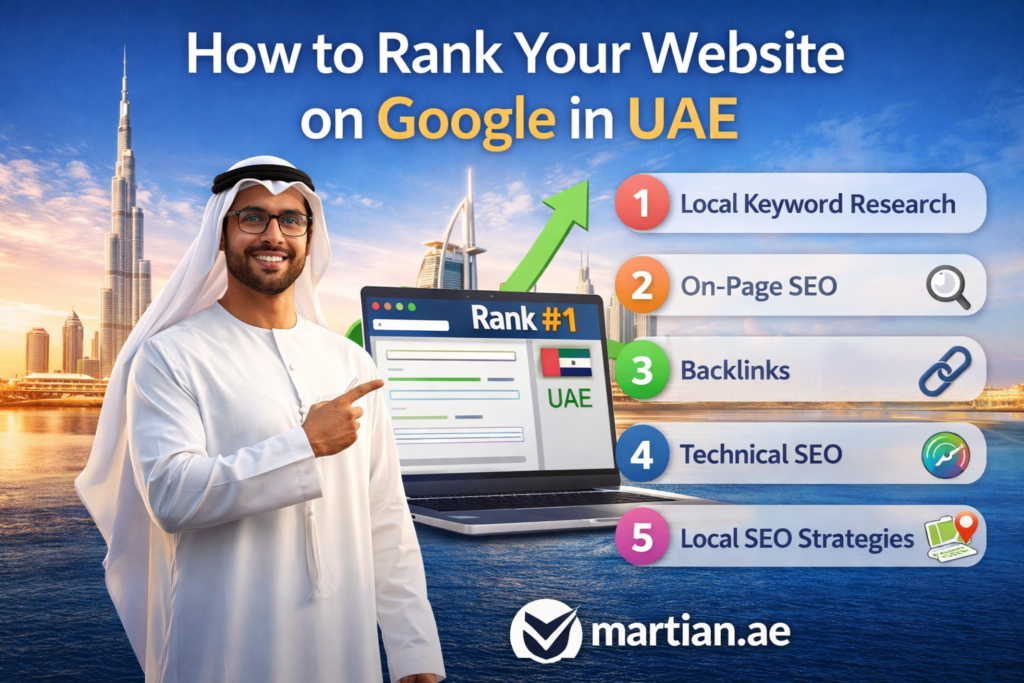
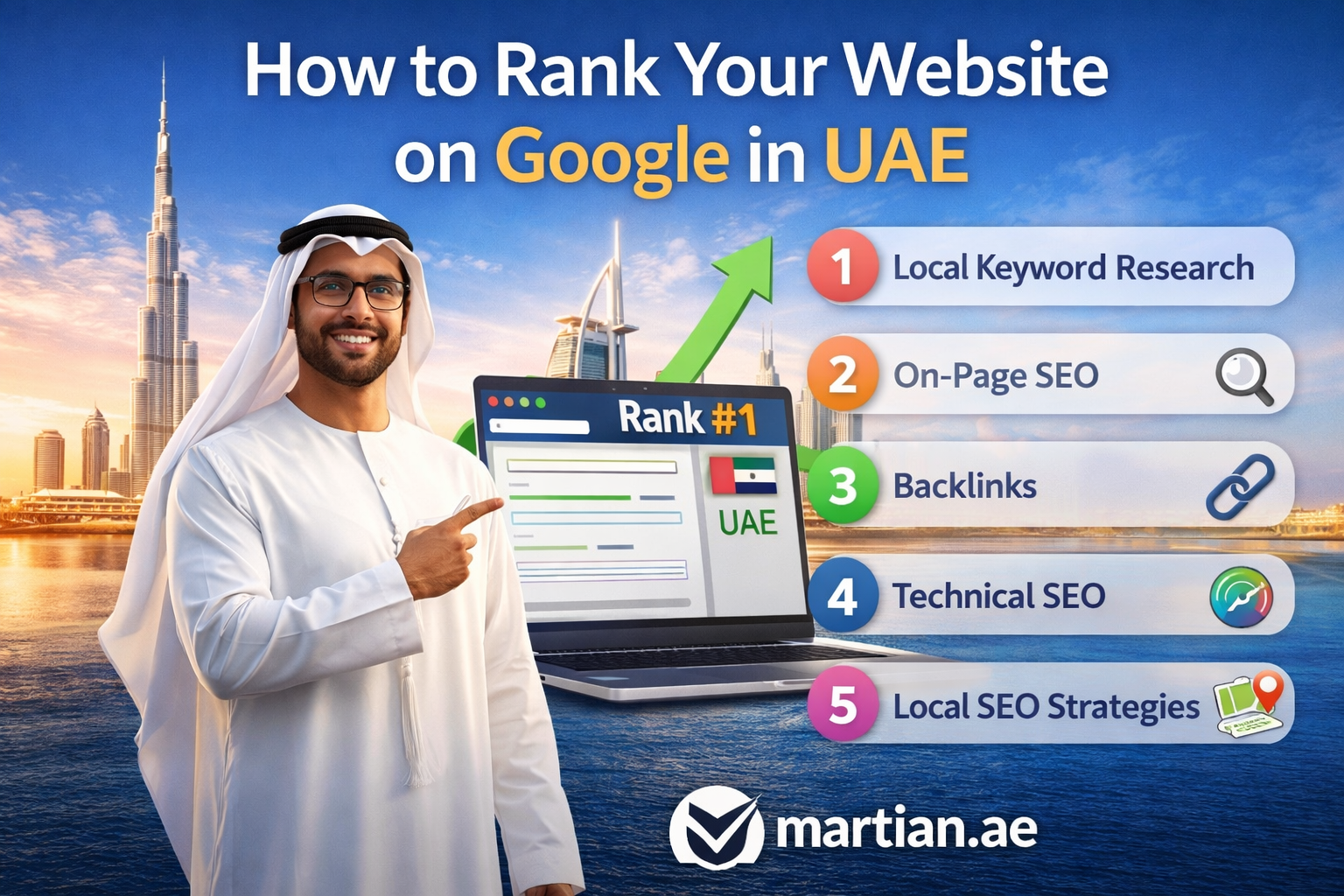
Step-by-Step: How to Rank Your Website on Google in UAE
Step 1: Fix Your Technical Foundation First
I say this first because it is the step most often skipped, and it is also where the most immediate gains tend to be hiding.
A site can look completely fine to a visitor and still have serious problems that stop Google from reading it properly. Crawl errors. Incorrectly blocked pages. Poor mobile performance scores. HTTP instead of HTTPS. These things sit quietly in the background and suppress rankings for months without the business owner knowing why.
Start with Google Search Console and open the Coverage report. Any pages flagged as excluded or showing errors need investigating. Run key pages through Google PageSpeed Insights and look at the mobile score specifically. Anything below 50 is actively hurting you. Check your robots.txt file to confirm you have not accidentally disallowed something important.
For most sites, fixing this stuff alone moves the needle before anything else has been touched.
Step 2: Find Out What Your Customers Are Actually Searching
This step gets underestimated constantly. Most businesses optimise for terms they think their customers use. Often those assumptions are wrong by quite a margin.
Search for your main service on Google right now. Look at the People Also Ask section. Scroll to the bottom and read the related searches. That is real data on how people in your market phrase things. Google Keyword Planner gives you volume and competition estimates on top of that.
Pay attention to location specificity. “Accountant Dubai” and “accountant Business Bay Dubai” are very different searches. The second one is far less contested, and the person typing it is usually far closer to picking up the phone. And if your customers include Arabic speakers, do this research in Arabic too. Direct translations rarely match what people actually type.
Step 3: Get Your Existing Pages in Order
Before building anything new, make sure what you already have is properly set up. Every important page needs a title tag under 60 characters with the target keyword in it, a meta description between 150 and 160 characters that gives someone a reason to click, a clear H1, and content that genuinely addresses the search it is targeting.
On title tags specifically, write them for the person searching, not for the search engine. A title that makes someone want to click will outperform one that mechanically includes keywords. Google tracks click-through rates and rewards pages that earn them.
Step 4: Build Content Around Specific Searches
Once existing pages are sorted, the work is identifying which searches your site has no answer for yet.
Each significant search query deserves its own dedicated page, not a passing mention somewhere. For UAE businesses this often means separate service pages for different emirates, blog content that answers pre-purchase questions customers have, and FAQ pages built around the specific things your industry gets searched for.
A page that exists to fill a content calendar does nothing. A page built around a specific query, written to answer it properly, tends to rank. The difference in intent is everything.
Step 5: Set Up and Maintain Your Google Business Profile
If you serve customers in a specific location, the local map pack is often more valuable than organic rankings. Those three listings appear above everything else in a local search. They include your phone number, rating, and directions link, all before the person has clicked anything.
Getting into the pack requires a completed and actively maintained Google Business Profile, genuine reviews coming in regularly, and NAP information (name, address, phone) that matches exactly across every directory where your business appears. For businesses targeting customers in Dubai, Abu Dhabi, or Sharjah, this is foundational.
Step 6: Build Links From Websites That Matter
When credible, relevant websites link to yours, Google reads it as a trust signal. Not all links are equal. One link from a respected UAE industry publication is worth more than fifty generic directory listings.
Practical approaches in the UAE market include contributing articles to relevant publications, earning coverage in local business or trade media, getting properly listed in legitimate UAE directories, and building relationships with complementary businesses. This takes time and also produces rankings that hold up long-term in a way that content alone cannot.
Step 7: Set Up Tracking and Keep Adjusting
Rankings shift. Competitors publish new content. Google updates its algorithm several times a year. Without tracking set up from the start, you will not know what is working and what is slipping.
Connect Search Console and Google Analytics before doing anything else, ideally. Search Console shows which searches are sending impressions and clicks. Analytics shows what those visitors do once they arrive. Check key rankings monthly. A page sitting on page two for a term that matters is your priority. It is already in Google’s consideration and usually needs specific improvements to move, not a complete rebuild.
Common Mistakes UAE Businesses Make With SEO
Going after keywords that are too broad. “Real estate Dubai” is fought over by the most well-funded websites in the country. “Off-plan apartments in JVC” is a real search with specific intent and far less competition. Build from specific to broad over time, not the other way around.
Letting mobile performance slide. This is a market where almost every search happens on a phone. A slow mobile site loses rankings regardless of how well everything else is optimised.
Writing content with no search target. A blog post on a topic nobody in your market is actually searching for generates no organic traffic. Every piece should be attached to a real keyword with real volume.
Not tracking before starting. Without a baseline, there is no way to know whether the work is producing anything. Search Console and Analytics take twenty minutes to set up. Do it first.
Quitting before it compounds. Two months is not long enough to judge SEO results in competitive UAE categories. Most businesses that stop early do so right before rankings would have started moving.
Pro Tips for Faster Results in the UAE Market
Most competitors in the UAE have never touched Arabic search. That means a significant share of searches in this market are essentially uncontested. If your customers include Arabic speakers, even basic Arabic optimisation on your most important pages puts you ahead of most businesses in your category. The effort-to-return ratio here is genuinely unusual.
Go narrow on geography first. “Tax consultant DIFC” is achievable in a timeframe that “tax consultant Dubai” is not. Once you own the specific terms, broadening is much easier.
Look into schema markup. Most UAE businesses are not using structured data, which means those that do stand out. Star ratings, FAQ snippets, and service details can appear directly in the search listing before anyone clicks. That changes click-through rates meaningfully.
Internal links are free and consistently underused. Linking between your own pages with descriptive anchor text tells Google how your content relates and distributes authority across your site. In our experience, spending an afternoon on this tends to show results within a few weeks.
To Close
Ranking on Google in the UAE comes down to doing the right things in the right order, then sticking with it. The businesses I see doing well from organic search are not doing anything exotic. They fixed the technical issues, built content around real searches, and did not stop.
The patience part is genuinely the hardest.
[Get Your Free SEO Audit] [Talk to an SEO Specialist]
Frequently Asked Questions
How long does SEO take in UAE?
Three to six months is realistic for most websites to see meaningful movement, assuming the work is consistent and technical issues are resolved early. Competitive categories in Dubai — real estate, healthcare, finance, legal — typically take nine to twelve months to reach strong first-page positions. The main variables are keyword competitiveness and where the site was starting from.
Can I rank without backlinks?
For low-competition searches, yes. Well-optimised content can rank without external links on less contested terms. As competition increases, links from relevant and credible sources become a deciding factor. You can deprioritize link building in the early months, but in most serious commercial categories in the UAE, you will hit a ceiling without them eventually.
Is SEO better than Google Ads in UAE?
Different tools for different needs. Ads give you traffic immediately but stop the moment the budget does. SEO takes longer but builds something that keeps running without a daily cost. Over 12 to 24 months, organic search usually produces a lower cost per lead than paid channels. Most UAE businesses doing this properly run both in parallel. Our SEO services in UAE work alongside paid campaigns for many of our clients. If you want a clear view of which mix is right for your business, our Digital Marketing Agency Dubai team is the right conversation to start.