
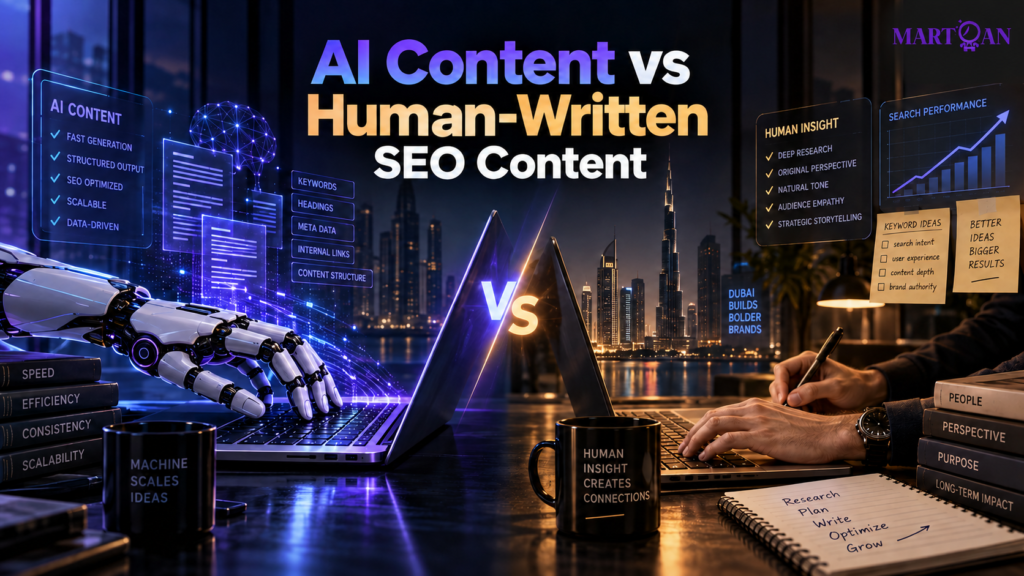
AI Content vs Human-Written SEO Content: What Actually Ranks in 2026
Key Takeaways
- Human-written content is roughly eight times more likely to hold the number one Google position than purely AI-generated content, based on a large-scale analysis of tens of thousands of ranking pages published earlier this year.
- Google does not penalise content for being AI-assisted. It penalises content that fails to demonstrate real experience, expertise, and originality, regardless of who or what typed it first.
- AI Overviews and AI Mode now decide a large share of visibility in search. Getting cited there depends on specificity and answer-first structure, not on avoiding AI tools.
- For regulated or high-trust sectors such as healthcare, finance, and education, EEAT signals are close to mandatory. Thin AI output struggles hardest here.
- UAE businesses face an added layer: bilingual Arabic-English expectations, PDPL-adjacent trust requirements, and a market where “contact us for pricing” content already reads as generic.
- A hybrid workflow, AI for research and structure, and a human for judgement, sourcing, and final voice, consistently outperforms either extreme on its own.
- Passing an AI detection tool like CopyLeaks is a symptom of good writing, not the goal itself. Chase sentence rhythm and genuine insight, and detection passes as a side effect.
Search marketers keep asking the wrong version of this question. AI content vs human-written SEO content isn’t really a contest between two writing methods. It’s a test of whether a page demonstrates something Google’s raters and its algorithms can actually verify: that a real person with real knowledge stood behind what got published. That distinction decides more ranking outcomes in 2026 than any prompt engineering trick or word count target ever will.
Semrush ran the numbers on this earlier in the year, pulling 20,000 keywords and their top 10 results across roughly 42,000 blog posts, then classifying each page by how it was written. Human-authored pages took the number one spot 80 per cent of the time. Purely AI-generated pages managed it just 9 per cent of the time. Moving down the results, the gap narrows; AI content shows up more often in positions three and four, but at the very top, where the clicks and the trust actually concentrate, human authorship still dominates by a wide margin.
That doesn’t mean AI tools have no place in a content operation. It means the industry has been asking the wrong binary question for two years. The real question isn’t AI or human. It’s which parts of the process actually need a human and which parts a machine handles competently enough that a human shouldn’t waste time on them.
Worth noting: the Semrush figures measure position, not just presence. AI content still shows up across page one with reasonable frequency. It just clusters lower, positions five through ten, where click-through rates drop off sharply. A page sitting at position seven for a competitive commercial keyword is functionally invisible next to one holding position one or two. So the gap isn’t really “AI content doesn’t rank.” It’s “AI content rarely wins”, and for most businesses, ranking without winning barely moves revenue.
What Google Actually Measures in 2026
Google has never claimed it detects and penalises AI-generated text as a category. Its public position, repeated through the March 2026 Spam Update and the subsequent core updates, stays consistent: content gets evaluated on whether it helps the person who searched for it, not on which tool produced the first draft.
What changed is enforcement capacity. SynthID watermarking and C2PA content provenance signals now feed into Google’s quality systems at scale, which means the company can identify unedited, mass-produced AI output far more reliably than it could in 2024. Once that content gets flagged, the usual quality signals kick in anyway: shallow claims, no sourcing, and generic phrasing that could apply to any business in any city. Pages built that way were already losing visibility before the detection got better. The detection just closes the gap faster now.
So when a UAE business owner asks whether AI content vs human-written SEO content is really about the writing tool, the honest answer is no. It’s about whether the finished page carries evidence of judgement. A large language model can assemble accurate sentences about, say, VAT compliance for Dubai retailers. It cannot tell you which specific documentation FTA auditors actually ask for first, because that detail lives in someone’s lived experience of sitting through an audit, not in a training dataset.
Why Human-Written Content Still Wins the Top Spot
Three mechanisms explain the 80-versus-9 gap, and none of them are mysterious.
First, specificity. Human writers, particularly ones close to a business or a client base, default to concrete detail: exact figures, named tools, and dated examples. AI models, left unguided, default to the statistically likely phrase, which tends toward the general. “Businesses should consider their budget” beats no answer at all, but it loses every time to “budget AED 8,000 to 15,000 for a mid-tier ecommerce build in Dubai, depending on payment gateway integration.”
Second, structural variation. Raw AI output tends toward uniform sentence length and predictable openers. Readers and algorithms both register that flatness, even without naming it. A page that varies its rhythm, from a short sentence to a longer one carrying real nuance, reads as considered rather than generated. That’s not decoration. It’s a genuine trust signal Google’s raters are trained to notice.
Third, and this is the one most agencies skip: original judgement calls. Good human content takes a position. It says a particular approach is overrated, or that a competitor’s advice is outdated, or that the “best” answer depends on a specific business condition the reader needs to check first. AI output, tuned to be broadly helpful and inoffensive, rarely commits to anything that pointed.
What EEAT Looks Like in AI Content vs Human-Written Content
EEAT, experience, expertise, authoritativeness, and trust are where the AI content vs human-written content gap becomes hardest to close artificially. Experience specifically cannot be simulated. A model can describe what a technical SEO audit involves. It cannot describe the moment a crawl budget issue turned out to be caused by a misconfigured hreflang tag on a client’s Arabic subdomain, because that’s a memory, not a pattern.
Expertise can be partially manufactured through good prompting and fact-checking. Authoritativeness comes from citations, backlinks, and brand recognition built over time, largely independent of how any single page got drafted. Trust is earned through consistency across many pages, not proven by any one of them. Put together, the four signals reward operations that treat AI as a drafting accelerant and keep a genuine expert in the loop for judgement, sourcing, and the final edit.
Where AI Content Actually Holds Its Own
None of this makes AI assistance a liability. For straightforward informational queries, definitions, basic how-to steps, simple comparisons, and AI-drafted content that gets a competent human edit performs close to parity with fully human work. The competitive gap opens specifically on high-stakes queries: anything touching money, health, legal standing, or a major purchase decision.
There’s also a speed argument that shouldn’t get dismissed. A content operation publishing weekly can use AI to handle first-pass structure, competitor synthesis, and metadata drafting, freeing the human writer’s time for the parts that actually move rankings: sourcing, original insight, and the sentence-level judgement that keeps a page from reading like every other page targeting the same keyword.
Volume matters too, quietly. A business that needs forty product descriptions written this month isn’t going to get every one of them hand-crafted by a senior copywriter, and it doesn’t need to. AI drafting, followed by a lighter human pass focused on accuracy and voice rather than a full rewrite, is a reasonable way to handle high-volume, lower-stakes content without draining the budget that should go toward the handful of pages actually competing for the money keywords.
The UAE Angle: Why This Debate Carries More Weight Here
Most of the content published on this topic treats it as a purely global SEO question. For businesses operating in Dubai and the wider UAE, three local factors raise the stakes.
Bilingual expectations change the calculus first. Arabic-English content that reads as machine-translated, rather than genuinely localised, signals low trust immediately to both readers and Google’s regional quality systems. AI translation tools have improved, but nuance, idiom, and cultural register still need a human pass, especially for anything client-facing in healthcare, finance, or education.
Regulatory sensitivity raises the bar further. Content touching data handling, financial advice, or medical claims sits close to PDPL, DHA, or DFSA-adjacent territory even when it’s just a blog post rather than a formal disclosure. Generic AI output that gets a claim slightly wrong, an outdated compliance figure, or a misstated licensing requirement creates real risk in a way that a lifestyle blog post never would.
And the competitive field genuinely lags. Search “content writing services Dubai“, and most agencies fielding for that term still lean on AI-assisted language as a selling point rather than a liability to manage. That’s a real gap. A UAE agency that can credibly claim its content clears CopyLeaks and reads with genuine local specificity, not because it avoids AI tools but because a human with real UAE market experience shapes every page before it publishes, is making a claim almost nobody else in the market is currently backing up.
There’s a seasonal dimension too, one that rarely comes up in global content advice. Ramadan, the Dubai Shopping Festival, White Friday, GITEX, each period shifts search behaviour and buyer intent in ways a generic AI model trained on largely Western data simply won’t know to anticipate. A human strategist who has actually planned a content calendar around Ramadan working hours and post-Iftar browsing patterns produces something a prompt cannot replicate on its own, however detailed the instructions.
How AI Overviews and AI Mode Change the Calculation
Ranking in the traditional ten blue links is no longer the only prize. AI Overviews now serve an estimated 2.5 billion monthly users, and AI Mode, Google’s more conversational search interface, has crossed a billion. Getting cited inside those answers depends on a different set of structural choices than classic ranking factors.
Answer engines pull content that states a direct answer immediately beneath a question-format heading, then backs it with a specific figure, named entity, or dated fact. Vague, hedged prose rarely gets quoted, because there’s nothing precise enough to extract. This actually favours the human-written approach described above: specificity and confident, well-sourced claims are exactly what both classic rankings and AI citation reward. The two goals point the same direction now, which simplifies the strategy considerably. Build for genuine usefulness and specificity, and both surfaces respond.
What Actually Gets Content Through Detection Tools
CopyLeaks, GPTZero, and Originality. AI all flag two underlying statistical patterns: low perplexity, meaning every next word is too predictable, and low burstiness, meaning every sentence runs roughly the same length and shape. Chasing a passing score by swapping synonyms treats the symptom, not the cause, and detectors adapt to word-substitution tricks fast.
The durable fix is structural. Vary sentence length deliberately within every paragraph. Break the habit of opening every sentence with the subject. Cut transitional filler like “furthermore” and “it’s worth noting” and let ideas sit next to each other the way people actually write when they’re explaining something they understand well. Content built this way tends to pass detection naturally, because genuine human writing has always had that irregular rhythm. The detector isn’t checking for a human name in the byline. It’s checking for the statistical signature of a mind that’s actually thinking while it writes, rather than predicting the next likely token.
A Practical Hybrid Workflow That Actually Works
The businesses winning this argument in 2026 aren’t choosing a side. They’re running a defined process. Start with AI for the unglamorous groundwork: competitor SERP analysis, initial outline structure, and first-pass metadata. Hand that scaffolding to a human writer or subject expert who adds the specific detail no model has access to, a real client figure, a genuine opinion about which approach works better and why, and an example pulled from actual project history. Run the draft through a structural humanising pass focused on sentence rhythm rather than word swaps. Fact-check every number and claim against a live, current source before publishing.
That sequence produces content that reads as authoritative because it is built faster than a fully manual process, but carrying the judgement calls a model still can’t make on its own. It’s the same logic behind why “AI-assisted” and “AI-generated” aren’t the same claim, even though competitors’ marketing content services often blur the two.
Common Mistakes UAE Businesses Make With AI Content
The most frequent failure isn’t using AI at all. It’s publishing the first draft with no expert review, no local specificity added, and no fact-check against current UAE figures or regulations. A close second is over-correcting the other direction: paying premium human-writer rates for content that still reads generic because the writer wasn’t given real client data, pricing, or case detail to work with. AI or human, a page with nothing specific to say underperforms a page that does.
A third mistake shows up less often but does more damage: treating AI detection as the finish line. A team polishes a page until it clears CopyLeaks, ships it, and moves on, without checking whether the content actually says anything a competitor’s page doesn’t already say. Passing detection confirms the writing sounds human. It says nothing about whether the writing is useful, accurate, or worth a reader’s time. Those are separate problems, and only one of them gets solved by a detector score.
Does Google penalise AI-generated content directly?
No. Google’s stated policy penalises low-quality, unhelpful content regardless of how it was produced. AI-generated pages that are thin, generic, or unedited tend to fail the same quality signals that would sink a poorly written human page, which is why they underperform in practice rather than by explicit rule.
Is 100 per cent human-written content always better for SEO?
Not automatically. A poorly researched, generic human article can rank worse than a well-edited, AI-assisted one. What matters is specificity, accuracy, and genuine expertise in the final piece, not the method used to produce the first draft.
How much does AI content actually underperform human content?
Recent Semrush data covering 42,000 blog posts found human-written pages held the number one Google position 80 per cent of the time, compared with 9 per cent for purely AI-generated pages. The gap narrows lower down page one but stays significant throughout the top results.
Can AI-assisted content pass CopyLeaks and similar detection tools?
Yes, when it goes through a genuine structural rewrite rather than a synonym swap. Detection tools flag uniform sentence rhythm and predictable phrasing. Content restructured for natural variation in sentence length and opener style typically clears detection because that variation is the actual signature of human writing.
What content still needs a human writer, regardless of AI capability?
Anything requiring first-hand experience, regulatory accuracy, or a genuine opinion. Healthcare guidance, financial recommendations, legal information, and any UAE-specific compliance content fall firmly into this category, where an incorrect AI-generated detail carries real consequences.
How should a Dubai business structure its content team around this shift?
Use AI for research, structure, and first-draft speed. Keep a human expert, ideally someone with direct UAE market or sector experience, responsible for fact-checking, local specificity, and the final edit. That combination tends to outperform either a fully manual or fully automated approach on both ranking and AI citation.
The Real Takeaway
AI content vs human-written SEO content was never going to end with one side winning outright. The data says human authorship still commands the top of the results, and the reasoning behind that gap – specificity, judgement, verified experience – isn’t going away just because the tools keep improving. Businesses that treat AI as a research assistant rather than a replacement writer, and that keep a genuine expert accountable for the final page, are the ones building content that survives the next core update instead of getting quietly buried by it.
If your current content library reads as if it could belong to any agency in any city, that’s the gap worth closing first, before word count or publishing frequency.
Contact us today if you really want to rank on the search engine.